As the 2026 partial government shutdown drags into its second month, a stark and uncomfortable contrast has emerged. While thousands of federal employees and military families scramble to cover rent and groceries, the 535 members of Congress continue to enjoy a suite of taxpayer-funded perks that remain largely untouched by the fiscal chaos they have failed to resolve.
The current deadlock over the Department of Homeland Security (DHS) has created a two-tiered reality: one of “essential” sacrifice for the workforce and one of “insulated” stability for the lawmakers.
The Perils: Life on the Frontlines of a Shutdown
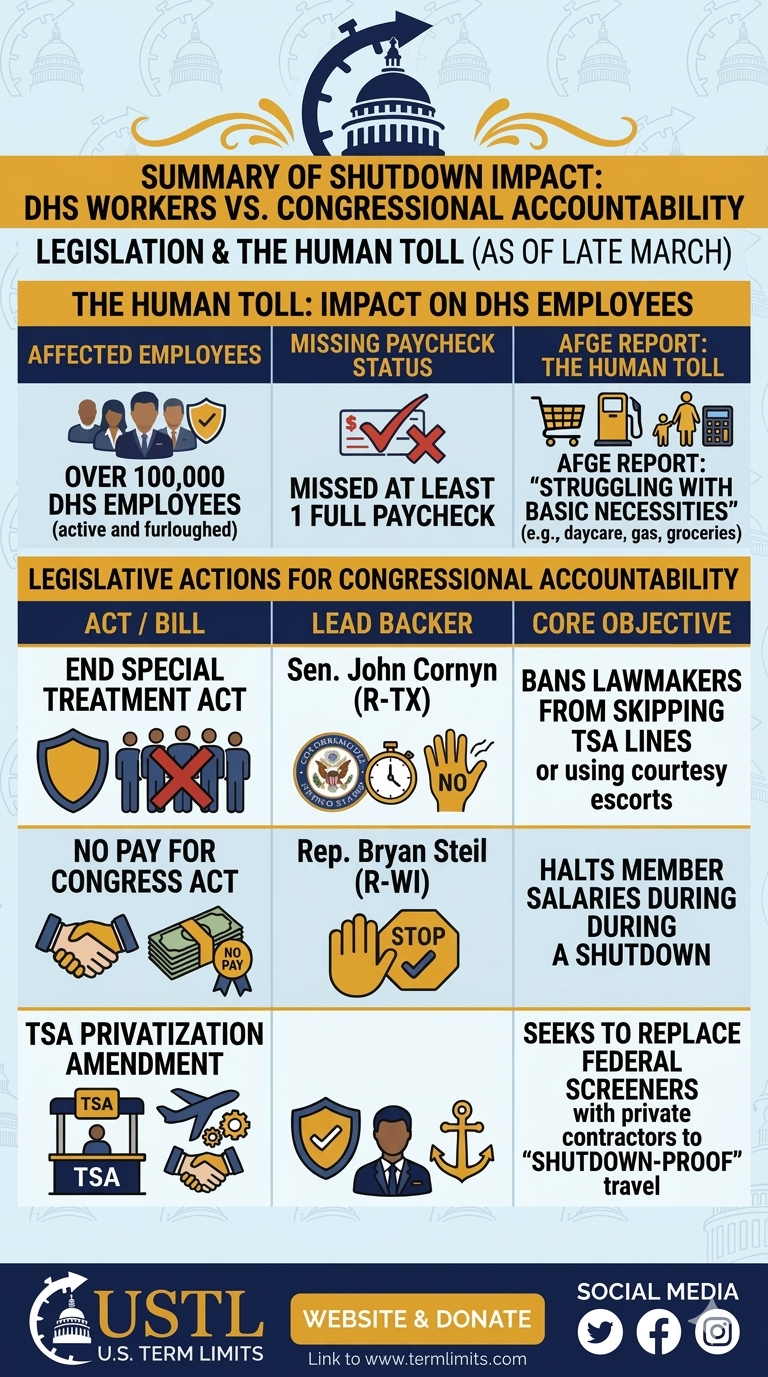
For the 250,000 “essential” workers at DHS, the shutdown is not a political talking point—it is a financial crisis. Since mid-February, these employees have been legally required to report for duty while their paychecks remain frozen in legislative limbo.
- Coast Guard Families: Unlike the other military branches, the U.S. Coast Guard falls under DHS. A recent bill has provided some relief for active-duty pay; thousands of civilian support staff and families still face disruptions in childcare subsidies and housing transitions.
- The TSA Crisis: Before recent retroactive pay orders, nearly 47,000 TSA officers worked for weeks without a dime. The stress led to a surge in “call-outs” and nearly 500 resignations, leaving those who stayed to manage massive security lines while wondering how to put gas in their own cars.
- The “Work for Free” Mandate: Federal law requires these workers to meet their personal financial obligations—mortgages, child support, and credit card payments—even when the government fails to meet its own payroll obligations.
The Perks: The Insulated Life of an Elite Lawmaker
While the people they represent face 4-hour TSA lines and empty bank accounts, Members of Congress continue to benefit from a system designed to protect their comfort and professional standing.
1. Guaranteed Paychecks
Perhaps the most glaring disparity is that Congressional salaries are not affected by a shutdown. Because their pay is considered a mandatory “permanent appropriation” under the Constitution, the $174,000 base salary for rank-and-file members continues to be deposited like clockwork, even as the agencies they oversee go dark.
Within the 119th Congress, several senators have spearheaded legislation designed to suspend congressional pay during government shutdowns. Despite these efforts, the bills have faced significant pushback and have consistently failed to move past legislative hurdles.
2. Specialized Travel and “VIP” Services
Until very recently, lawmakers bypassed the very travel misery caused by the shutdown. While constituents stood in TSA lines for 2 to 4 hours, lawmakers enjoyed their elite status. Through “Capital Desks” at major airlines like Delta and United, members of congress received:
- Escorted Gate Access: “Red Coat” assistants to lead them past standard security lines.
- Elite Booking: 24/7 dedicated phone lines for last-minute changes that average citizens cannot access.
- Note: While Delta recently suspended some of these “white glove” perks in protest of the shutdown, the dedicated booking desks remain open.
3. The “MRA” and Daily Comforts
The Members’ Representational Allowance (MRA)—a budget of roughly $1.8M to $2M per office—ensures that congressional staff (the “cogs” of the political machine) continue to be paid from separate pots of money. Furthermore, on-site perks like exclusive member-only gyms, private dining rooms, and reserved parking at D.C. airports remain operational and staffed.
2. Specialized Travel and “VIP” Services
Until very recently, lawmakers bypassed the very travel misery caused by the shutdown. Through “Capital Desks” at major airlines like Delta and United, members received:
- Escorted Gate Access: “Red Coat” assistants to lead them past standard security lines.
- Elite Booking: 24/7 dedicated phone lines for last-minute changes that average citizens cannot access.
- Note: While Delta recently suspended some of these “white glove” perks in protest of the shutdown, the dedicated booking desks remain open.
3. The “MRA” and Daily Comforts
The Members’ Representational Allowance (MRA)—a budget of roughly $1.8M to $2M per office—ensures that Congressional staff (the “cogs” of the political machine) continue to be paid from separate pots of money. Furthermore, on-site perks like exclusive member-only gyms, private dining rooms, and reserved parking at D.C. airports remain operational and staffed
A Growing Movement for Accountability
The optics of lawmakers enjoying “operational upgrades” to first class while TSA agents struggle to buy groceries has finally triggered a legislative backlash.
The Bottom Line
As the shutdown reaches record lengths, the American people are being reminded of a hard truth: the system is designed to keep the “Capital Bubble” intact while the rest of the country feels the air escape. Until acts like the No Pay for Congress Act become law, the incentive for a swift resolution remains low for those holding the checkbook.
For the Coast Guard spouse or the TSA officer at Reagan National, “home” is a place of rising bills. For the Members of Congress, “home” is a district they can still fly to with ease, funded by the very people currently waiting for their back pay.