
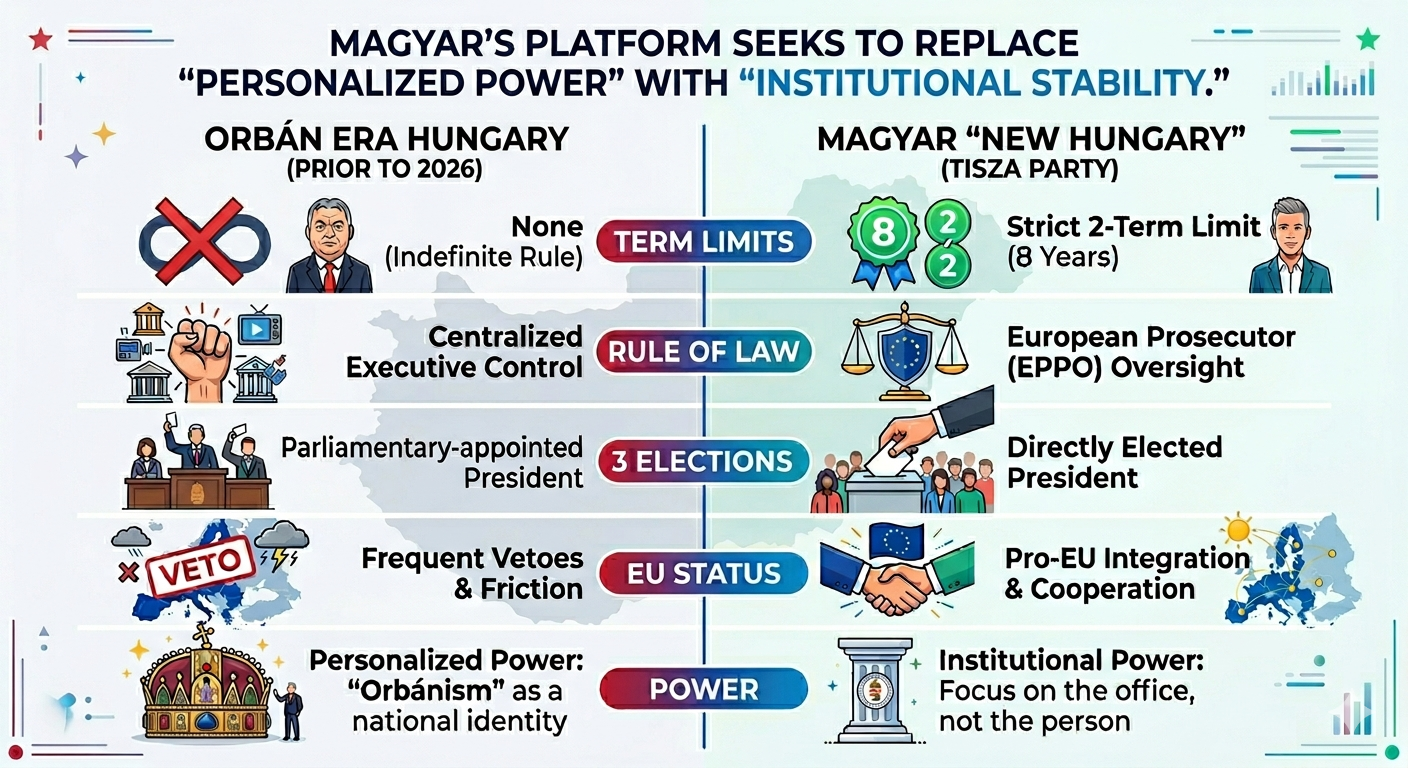
For sixteen years, Viktor Orbán’s grip on Hungary seemed unbreakable. By leveraging a constitutional system that allowed for indefinite rule, the “Illiberal” giant became a permanent fixture of European politics. However, on April 12, 2026, the tide finally turned in a landslide that has reshaped Central Europe. (The Guardian)
Péter Magyar and his TISZA Party (Respect and Freedom) secured a historic two-thirds supermajority. This victory wasn’t just a change in leadership; it was a mandate for a total democratic reset. At the heart of Magyar’s “New Hungary” platform is a single, transformative policy: a strict constitutional limit of two terms for the office of Prime Minister, designed to dismantle the machinery of “eternal” power forever. (Wikipedia) (The Guardian)
Who is Péter Magyar? From Fidesz Insider to Reformer
Péter Magyar, a 45-year-old lawyer and former diplomat, was once an integral part of the Hungarian political establishment. As the former husband of ex-Justice Minister Judit Varga, Magyar spent years within the Fidesz inner circle, moving comfortably through the highest echelons of power. (Time Magazine)
His defection in early 2024—sparked by a massive corruption and pardon scandal—transformed him into an insurgent leader. Magyar leveraged his deep knowledge of the system to expose what he called a “mafia state,” quickly becoming the face of a grassroots movement. He resonated with citizens tired of high inflation, healthcare shortages, and political stagnation. Having witnessed the inner workings of the Orbán government, Magyar campaigned on a simple philosophy: unlimited power inevitably leads to systemic corruption. (AP News) (European Policy Centre) (Time)
The Term Limit Revolution: Capping the Premiership
The most significant pillar of Magyar’s campaign is the Anti-Autocracy Amendment. This proposal aims to ensure that no future leader can replicate Orbán’s sixteen-year tenure. Magyar argues that the primary cause of Hungary’s democratic backsliding was the ability of one man to hold onto power for nearly two decades without interruption.
Key Features of the Constitutional Reform:
- he 8-Year Cap: A strict constitutional limit of two four-year terms for the Prime Minister.
- Preventing “Power Recycling”: The law is designed to ensure a leader cannot step down and return later to bypass the limit.
- Retroactive Accountability: Magyar has pledged that these limits will apply to past service, effectively barring Viktor Orbán from ever seeking the premiership again.
- Decentralized Power: To further balance the scales, Magyar intends to have the President of Hungary popularly elected by the citizens, creating a separate democratic check on the executive branch.
“A leader who believes they are the only person capable of running a country has already failed that country. Power is a loan from the people, not a permanent possession.” — Péter Magyar, Election Night 2026. (The Guardian)
Why Term Limits Defined the 2026 Campaign
Magyar’s focus on term limits resonated with an electorate that had seen the same leadership for a generation. The campaign successfully framed the two-term limit as the ultimate anti-corruption measure, promising a government that is accountable, temporary, and focused on the future rather than individual legacy.With a supermajority in hand, Magyar now has the “legal hammer” to codify these changes, signaling to the world that Hungary is ready to trade “illiberal” stability for a dynamic, rotating democracy. (The Guardian)
A New Chapter for Hungary
Péter Magyar’s rise proves that the desire for democratic checks and balances remains strong in Central Europe. By prioritizing term limits and transparency, Hungary is positioning itself as a laboratory for democratic recovery. As Magyar prepares to take office in May 2026, the world is watching to see if this “New Hungary” can successfully transition from a decade of one-man rule to a sustainable, modern democracy.