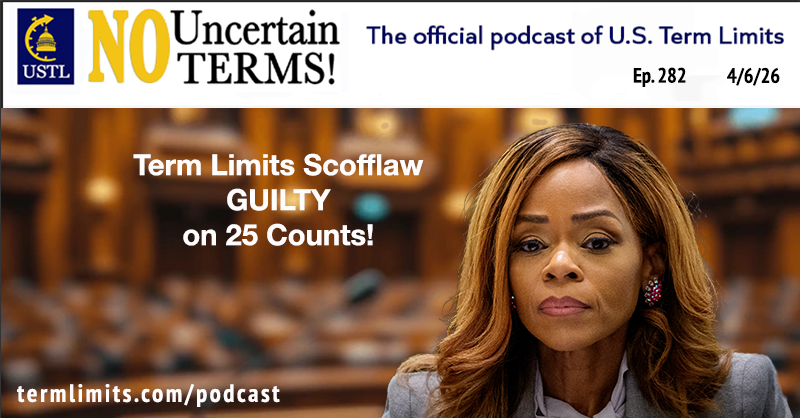
Philip Blumel: Term limits scofflaw guilty on 25 counts. Hi, I’m Philip Blumel. Welcome to No Uncertain Terms, the official podcast of the term limits movement. This is episode 282, published on April 6, 2024.
Stacey Selleck: Your sanctuary from partisan politics.
Philip Blumel: In March, a bipartisan panel of the House Ethics Committee found term limits scofflaw Representative Sheila Cherfilus-McCormick of Florida guilty of 25 counts of misconduct. The Ethics Committee says she illegally funneled a $5 million overpayment in COVID-era funds from the state of Florida to her successful campaign for Congress in a 2022 special election. She is also currently under indictment for this crime. The eight-member subcommittee decided they would have another hearing to decide what to do with her when they get back from recess around April 14. Cherfilus-McCormick could be expelled from the Congress, which would require a two-thirds vote. While that could happen, there’s been a growing number of calls from fellow Democrats for her to resign. The dishonesty of this congressmember did not come as a surprise to the term limits movement or US Term Limits. And before her election to Congress, she signed the US Term Limits congressional pledge to co-sponsor and vote for the term limits constitutional amendment bill. And US Term Limits, as we do, sent out press releases and social media and everything educating voters that she had signed this pledge and intended to be a supporter of term limits in Congress.
Philip Blumel: But once elected, she basically stopped answering our calls. She refused to follow through with the simple promise that she made to sign on as a co-sponsor of the damn bill. So then US Term Limits ran billboards in her district alerting voters about her broken pledge. In the midst of this controversy, the indictment dropped, exposing Representative Sheila Cherfilus-McCormick as a liar and a crook. Sadly, we knew that already. Next, the term limits convention bill is still being considered by about a dozen states this year. As we reported in the last episode, Kansas is the most recent state to officially apply for the Article 5 amendment proposing convention, which would be limited to the subject of congressional term limits. That is state number 13. More to come. Stay tuned.
Speaker 3: This is a public service announcement.
Philip Blumel: Last October, David Trone, a co-chair of U.S. Term Limits’ project to pressure Congress with the threat of an Article 5 term limits convention, led an all-star panel of Pennsylvania Democratic legislators calling for the state to pass the convention resolution. The event was held at the National Constitution Center in Philadelphia. Among the participants was Pennsylvania State Rep Jared Solomon, the sponsor of the term limits convention bill.
Speaker 4: Representative Solomon, Pennsylvania was one of the states that ratified the 22nd Amendment to term limit the president in 1951. And this year, State Representative Ben Waxman, a Democrat from Pennsylvania, led an effort to commemorate this, of which U.S. Term Limits endorsed the resolution. Do you believe that Pennsylvania is going to be one of the states to finally achieve the congressional term limits America is clamoring for?
Jared Solomon: I think that’s up to the folks in this audience. If you were with Rep Young and I in Harrisburg and you went through our calendar and you looked at the stakeholder interest groups that are coming before us, how many of you think that there are any kind of institutional reform folks that come talk to us besides Aaron? Seriously, besides Aaron, do you think any? Nothing. Right? So we have education lobbyists, healthcare folks. We have folks coming to us talking about precious metals. Came to Harrisburg, precious metals. What are you talking about, precious metals? But they’re there. They have a whole team. It’s not just one precious metal folks, you got a team. This issue is unique in that this relies purely on all of you to consider clamoring for this reform, to hold our elected class accountable.
Jared Solomon: You going to your elected officials, state senators, state reps, and saying, “We need you to act now,” because you are our team of stakeholders and lobbyists and interest groups right here in this audience. We need you now more than ever. And by the way, we are in the perfect spot to be doing this in Philadelphia, where it all started, actually at the perfect moment right before 2026 as we celebrate 250 years of our democracy. What a great way to ring that in is if we took significant steps to bring term limits to Congress and we were the next state to move right here in the Commonwealth of Pennsylvania. But to get that done, we need the power of the people, and the people are sitting right here, and we need your help.
Philip Blumel: Leading the panel was David Trone, the former Democratic Congressmember from Maryland and also co-founder of Total Wine & More. In an insightful moment, Trone explains how term limits are necessary for positive change.
David Trone: So I would build on what was already said. I mean, the delegate is absolutely 100% right. You need more than one term to kind of figure out which way things are and how things work. But at the same time, the deck is stacked against you to get things you want to accomplish as a first-temer or a second-termer. And why is the deck stacked against you? Because you have no seniority. And everything in the US Congress is all about who lived the longest. Did we ever decide that if you live the longest, you should be in charge of our country? Does that make any good sense? But that’s how Congress works. If you live the longest, you get to be in charge of appropriations. If you live the longest, you get to be in charge of armed services, et cetera, et cetera. That’s one dumb idea. And in business, we see that as a loser. It’s all gotta be about merit, merit, merit.
David Trone: And when a person comes in and without term limits, it’ll take you 30 to 40 years. I was on the Appropriations Committee, to get chairman of approps, it’s gonna take you that long, 30 to 40 years. And you have to stay alive. Not easy. Not easy. So it’s a real tough battle. But if we had term limits, we could turn and churn some of those folks. And if they were really smart and they had ideas, maybe two, three, four terms in, they could be in charge of a committee. Forget seniority. Seniority is a poison that kills all ideas. We need ideation, what we need. So if we had these term limits, young folks, different folks, diverse folks would come in, serve 8, 10, 12 years, whatever the number might be, and then leave and go back to their job, be a businessman, a teacher, a union official. All those things are great, but you gotta have somewhere to go back to. But when your only job is to get re-elected, that isn’t a good formula for success. It’s merit and killing seniority.
Philip Blumel: Next. Do lobbyists like term limits? Yeah, I know. The answer is so obvious that it seems silly to even bring it up. But politicians keep proclaiming the answer is yes. So we have to keep rebutting them over and over again. To do so today, we turn to the work of U.S. Term Limits CEO Nick Tomboulides. As Nick has written, when the modern term limits movement burst on the scene in the 1990s, career politicians in Congress faced a dilemma. They needed to find a way to oppose term limits while not appearing to be self-serving. They had to convince the public that term limits was an objectively bad idea, not just something they didn’t like because it would end their own careers. Their solution was to concoct one of the most absurd yet enduring political myths: the claim that lobbyists somehow benefit from term limits. This claim incubated in early term limits debates. It was exemplified by the 41-year US Senator Mitch McConnell saying that term limits would make Congress far more dependent on unelected staff and lobbyists. The National Conference of State Legislatures, Council of State Governments, and State Legislative Leaders Foundation even collaborated on a research project called the Joint Project on Term Limits, which concluded that term limits expand the influence of lobbyists.
Philip Blumel: How did the JPTL reach this conclusion? Well, by asking lots of legislators and lobbyists to comment on term limits. As we later learned, this was like asking inmates to comment on the need for prison bars. Over time, it spread like wildfire through the cloakrooms of Washington and the state capitals. Elected officials at all levels became trained through repetition and muscle memory to repeat the lobbyist claim. There’s only one problem, it isn’t true. From the inception of the term limits movement to the present day, lobbyists everywhere have always opposed term limits. And they’ve done so passionately, aggressively, and with millions of dollars behind them. Now, there’s only two explanations for this phenomenon. Either one, the national lobbying community has lost its marbles and is waging war against itself, or two, term limits would curb the power and influence of lobbyists. In his book Capital Punishment, the ex-felon mega-lobbyist Jack Abramoff has spilled the beans on exactly why lobbyists oppose term limits.
Philip Blumel: “When I was a lobbyist, I opposed term limits for representatives. I truly believed it was wrong for the voters to be limited in their choices. But that wasn’t the only reason I opposed them,” Abramoff said. “Like every lobbyist I knew, I didn’t want to have to build relationships with new members constantly. A representative who stayed in office for decades and was a friend was worth his weight in gold.” All right. Well, to see whether Abramoff’s claim is true, Nick decided to follow the money. After all, if lobbyists are such fans of term limits, they would have spent their precious dollars on campaigns to enact and defend them, right? They’d be giving money maybe to US Term Limits. Well, it turns out that that’s not the case at all. Since 2004, four states have conducted statewide term limits campaigns. In three of them, Arkansas, California, Michigan, the state legislature had referred measures to the ballot attempting to lengthen term limits so lawmakers could remain in power longer. Now, I have a chart that I’ve used over the years when I do public speaking that I like to show. And it’s a list of all these Arkansas special interest lobbying groups and where they put their money during the term limits battle.
Philip Blumel: And it turns out that all the biggest lobbying associations in Arkansas sought to loosen the term limits, to weaken them, and to move the state back towards a permanent politician model. Now, the same thing happened in California in 2012. Lobbying groups threw all their financial weight behind the anti-term limits effort. Michigan, same story. In 2022, lawmakers there referred an anti-term limits amendment to the ballot. A total of 24 individuals and organizations poured almost 1.35 million into the ballot committees aimed to defeat term limits. The committee in favor of term limits, called No More Time for Career Politicians, only raised a little over $140,000, or a mere 10 and a half percent in comparison to their well-heeled opponents. If term limits truly benefited lobbyists, those contributions would have gone to the committee advocating stricter terms. In North Dakota, the state’s lobbying community made the mistake of saying the quiet part out loud. They gathered in a joint press conference ahead of the state’s 2022 vote on the matter to announce, get this, that term limits would harm their ability to influence members.
Philip Blumel: Oops. In fact, we have found zero evidence in any state of industry group lobbyists supporting term limits. It makes sense, right? As Abramoff suggests, lobbyists and the special interests they represent never want to see their codependent relationships with career politicians come to an end. Why would they? Term limits make lobbyists work harder while ensuring a constant influx of new ideas into government. It forces lobbyists to make arguments on the merits rather than just rely on their relationships, and lobbyists don’t like that. After locating the campaign finance data, we can prove that lobbyists oppose term limits. But it also helps to know why. That help came in the form of a study from London School of Economics professor Jordi Blanes i Vidal. Blanes i Vidal’s seminal paper, Revolving Door Lobbyists, revealed the exact reason why lobbyists are so opposed to turnover in Congress. Their success and profitability depend on keeping relationships with incumbents.
Philip Blumel: His research showed that ex-staffers of career politicians in Congress see a massive drop in their lobbying income, 24%, when their former boss retires. This establishes that lobbyists become less valuable and less effective when there is higher turnover. Since term limits on Congress would produce unprecedented turnover, the value of lobbyists’ prior relationships would collapse quickly. Blanes i Vidal was even able to calculate the specific amount that these valuable relationships are worth. According to the report, ex-staffers turned lobbyists earned on average $177,000 less after their ex-employer left the Senate. The generated revenue dropped immediately following the ex-employer’s exit from Congress and did not recover even after several years. The effect was even larger for lobbyists connected to departing members of Congress serving in the money committees, such as the Senate Finance, Senate Appropriations, and House Ways and Means. Of course, Blanes i Vidal’s research looked at former staffers, but there’s no reason it wouldn’t also apply to any lobbyist who has developed relationships.
Philip Blumel: When their favored senator retires, as Abramoff alluded to, they have to start all over again with a new member. For a lobbyist under term limits, that’s quite a challenge. And there’s other academic literature that shines light on this question. Until recently, political scientists employed a survey method to determine the net effect of term limits on lobbyists. In other words, they would simply ask legislators and lobbyists to rate the impact of term limits. This didn’t show the actual impact of term limits, it only provided these insiders’ opinions. But term limits research took a major leap forward in 2021 when Cambridge University published an empirical analysis of the subject called K Street on Main: Legislative Turnover and Multi-Client Lobbying. The Cambridge study found that term limits and turnover on state legislatures, 15 states have them at the time, one, disrupted the relationships between lobbyists and legislators. Two, reduced the growth of lobbyist networks. And three, reduced multi-client lobbying overall. According to the papers, term limits successfully thwart lobbyist efforts to build influential relationships. So let’s wrap this up. The final word on this question is that not only is there no support for the argument that term limits benefit lobbyists, but there is overwhelming evidence to suggest that term limits hinder lobbyists and their special interest clients. And this is why U.S. Term Limits is always and everywhere battling with special interest lobbyists over the issue of term limits. Got it? Good.
Stacey Selleck: Like the show? You could help by subscribing and leaving a five-star review on both Apple and Spotify. It’s free.
Philip Blumel: Thanks for joining us for another episode of No Uncertain Terms. The Term Limits Convention bills are moving through the state legislatures. This could be a breakthrough year for the term limits movement. To check on the status of the Term Limits Convention resolution in your state, go to termlimits.com/takeaction. There, you will see if it has been introduced and where it stands in the committee process on its way to the floor vote. If there’s action to take, you’ll see a Take Action button by your state. Click it. This will give you the opportunity to send a message to the most relevant legislators, urging them to support the legislation. They have to know you’re watching. That’s termlimits.com/takeaction. If your state has already passed the Term Limits Convention resolution or the bill has not been introduced in your state, you can still help. Please consider making a contribution to U.S. Term Limits. It is our aim to hit the reset button on the US Congress, and you can help. Go to termlimits.com/donate. Termlimits.com/donate. Thanks. We’ll be back next week.
Stacey Selleck: Find us on most social media @USTermLimits. Like us on Facebook, Twitter, YouTube, Instagram, and now LinkedIn.