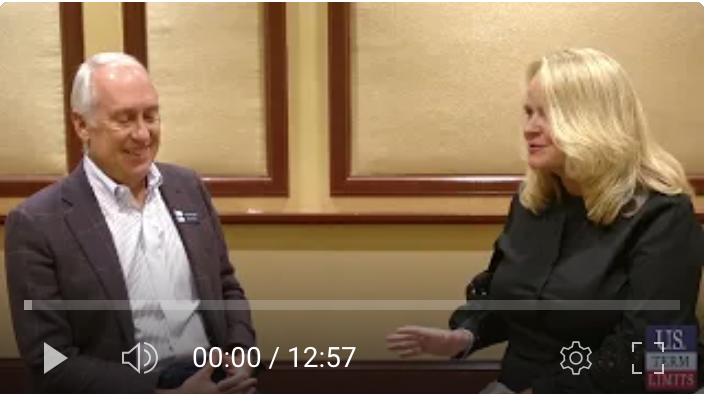

Philip Blumel: Trone to fellow Democrats, let’s revitalize American democracy. Hi, I’m Philip Blumel. Welcome to No Uncertain Terms, the official podcast of the term limits movement. This is episode number 284, published on May 11, 2026.
Stacey Selleck: Your sanctuary from partisan politics.
Philip Blumel: We’re going to do something very different in this episode of No Uncertain Terms. On the advice of one of our field team, this is going to be what they call a long-form podcast. Why? Well, because in December, an extraordinary event was held at the National Constitution Center in Center City, Philadelphia. Former Representative David Trone of Maryland, the founder of Total Wine & More and now co-chair of the US Term Limits convention campaign, led a panel on term limits accompanied by Democratic legislators, both current and former. It’s long-form because as we’re trying to edit into digestible pieces, we realized that the whole event was gold. It also seemed to rob the historic nature of it by reducing it to sound bites. Now, it was a Democratic event because the term limits convention bill is being carried by Democrats in Pennsylvania, primarily sponsor Representative Jared Solomon, who joined Trone on the panel. And also on the panel was Representative Regina Young and former Pennsylvania State Senator Andy Dinniman. The moderator of the event was Cesar Chavez, a senior advisor for US Term Limits in Arizona and a former Democratic Arizona legislator. Speaking of Arizona, in the last episode of No Uncertain Terms, Chavez helped lead the Arizona legislature to a bipartisan approval of the term limits convention resolution in that state last month.
Philip Blumel: Arizona is now the 14th state to officially apply for the amendment proposing convention under Article 5 of the US Constitution, limited to the subject of congressional term limits. The aim of the convention project is to force Congress to act on the subject as it has traditionally in the face of a convention threat. But enough of my talk. Let’s roll the tape. We’ll start with Cesar Chavez.
Cesar Chavez: Good evening, everybody. As she mentioned, Cesar Chavez. It’s great to be here. We’re definitely not in Arizona because it’s cold as hell. But I actually grew up outside of Philadelphia in Westchester County, and so it’s great to be back after many, many years. It’s great to work alongside some of the folks at US Term Limits nationally, but specifically in Arizona, where we are very, very close to getting this across the finish line. I serve as a senior advisor for US Term Limits and a staunch supporter of it since I was in the legislature. But it’s my honor to welcome you all to the National Constitution Center for our panel, Term Limits: Reinvigorating Democracy. And tonight, as you all know, we’re here for a lively discussion on this issue, an issue that 87% of Americans agree should be implemented in regards to congressional term limits. We’re joined by some fine key leaders in this topic, people that have moved this topic forward. We have former Congressman and founder of Total Wine, David Trone, Pennsylvania State Representative of the 202nd District, Jared Solomon, Pennsylvania State Representative of the 185th District, Regina Young, and US Term Limits Pennsylvania co-chair and former State Senator Andy Dinniman.
Cesar Chavez: So thank you all very much. Please give them a round of applause. [applause] We’re going to begin with some opening statements from our panelists. So we’ll start with the Congressman to introduce himself, share an experience that influenced his view on congressional term limits.
David Trone: Quite simply, I’ve always loved the idea of term limits. It seemed like you come and serve, then you go back to what you were doing in your life. But to do that, you have to have a life. That means a job that’s not a professional politician. So but when I got to Congress and saw what was around me, I grew to love term limits, because I realized we had a lot of folks that were just mailing it in, putting in the time, collecting a check, and not being a real public servant to move the needle like we could and should if we had new people, new voices, new ideas. So that’s how I got here and I’m delighted to help out on this.
Cesar Chavez: Perfect. Representative Young.
Rep. Regina Young: Sure. I will say that what brought me to this space is my desire to want to learn a little bit more. I do believe that this is a space in politics that can consume you if you would allow it. And I think because it’s such a fast-moving train, before you know it, 20, 30 years has passed and you’re not as effective as you believe you were when you first started. And I do believe that we need to help our colleagues in this space become a little bit more conscious on creating succession plans and really educating just our everyday people about what civic responsibility looks like, what engagement looks like, and what can happen if we all are included in a democratic process.
Cesar Chavez: Perfect. Representative Solomon.
Rep. Jared Solomon: Good evening, everyone, and thank you so much for being here. How many folks think that Congress is a failing institution?
Rep. Regina Young: Or government and thereabouts.
Rep. Jared Solomon: Okay, so who thinks that Congress is working currently? Do we have folks? You can say yes. I’m not going to shame anybody. And how many believe that one antidote to this failing institution is term limits? Some. Most. Most. Probably reflective of around 90% of the room. I would agree with all of you. Congress is a failing institution, and it sort of follows what we in the political class have continued to do, which we have sort of given a bear hug, a warm embrace to institutions that are failing people. If you look at the financial crisis, Great Recession, ’07 and ’08, what did we do? Did we prosecute folks in the financial industry? Not a one. And there was really no reckoning with that. If you look at the Iraq War, we sent our treasure, our men and women abroad, and really never had a reckoning on that. Most recently, COVID. We got a lot wrong during COVID, and there’s really never been an exploration of the issues that we in government could have done better.
Rep. Jared Solomon: When institutions fail, we need to call it out. We need to confront those issues squarely. That’s what people expect: accountability, candor, and courage. This proposal to limit the terms in Congress brings us back to a place of accountability, and I’m proud to be here and proud to be a supporter.
Andy Dinniman: Well, good evening, and it’s good to be here as well. My own view comes through my experience both as a state senator and as a professor. We are now in the greatest period of change in all of human history, and this is very disruptive to the institutions that we have depended on. And the worst thing you could do during a period of change is to assume that what might have worked in the past works now. And Congress simply, I’m not sure it even worked in the recent past, but it sure doesn’t work now. So we need to become aware of how do we… How in this era of change can we bring about institutions that work, institutions that truly reflect the people, and institutions that keep American democracy alive and well? So that’s how my interest evolved and continued to evolve. And let me say one other thing about tonight. When I started this as a Democrat, I got a lot of resistance out of my caucus. But fortunately, I could get away with things because I was the first Democrat to be elected out of Chester County since the 19th century.
Andy Dinniman: So they didn’t bother me too much. But the point is that now you see a change in the perspective of so many Democrats. Actually, President Trump did us a favor, whether you like him or you don’t like him, when he said he was going to run for a third term. That got the Democrats all revved up. And that’s fine, if they’re revved up for the right cause, right? So we have an opportunity now to bring all this together, and Pennsylvania is that state in which I believe we can get this accomplished. Listen, how many issues do you know of that have this type of bipartisan support? How many issues are there out there where people understand and are willing to change, not just simply for change, but change because they know they have to? And if we really are a democracy, if we really are an institution representing the people, then we should respect what the people have to say and act on it. So this is a good event tonight, and I hope that we’ll have similar events throughout Pennsylvania. My co-chair is one of the most conservative Republicans in the Senate, but a wonderful guy.
Rep. Jared Solomon: His name is Eichelberger, and he and I found ways to move education, we’re both chairs of the Education Committee, move education forward. So I know that consensus can be achieved. And believe me, with all of your help, we will do it.
Cesar Chavez: Thank you all very much for that wonderful insight on this issue. And actually, as a follow-up, I just received a question… And I’m sorry if I butchered your name from Marilyn, Marlon. The question is, is it true that newly elected people have a very difficult time getting their campaign promises fulfilled? As we’re talking about term limits, many people say, many elected officials say, “I still need one more term because I haven’t been able to fulfill my campaign promises.” But is this an excuse when they are newly elected as junior members? And we will start on your side, Senator Dinniman.
Andy Dinniman: Yeah, it’s an excuse. Politicians, those of us who are politicians are very good at making up reasons why you should re-elect us. Isn’t the bottom line of almost any senator or representative to get re-elected? As a professor, my bottom line was not to fail all my students so that actually I could, so that I taught them. As a business person, as Representative Trone knows, once you don’t make any money, you no longer have a business. So understand that concept within the concept of what the bottom line is for senators and representatives. And I think that’s the key. Also understand that despite what new people or other people say, that we have a new generation of young people who want to get their turn too. And so this is all very important. Thank you.
Cesar Chavez: Representative Solomon.
Rep. Jared Solomon: Yeah, Marlon, that’s a really good question. Marlon’s actually from Northeast Philly, so not surprising it’s a really good question. I’m a rep from Northeast Philly. [laughter] So I’m sympathetic to that because campaigns are fun. You can say anything on the campaign trail. “I’m going to decrease health care costs. I’m going to increase education funding. I’m going to remove blight in neighborhoods. I’m going to rebuild our business corridors.” And then you take office. And it is a little unnerving because you do realize that you don’t have any understanding how you’re going to deliver on those promises. Most of us have never been in the legislature before. And what you learn is it takes an inordinate amount of work and relationship building to actually deliver. Some people have zero interest in building those relationships. My Republican colleagues may, and maybe some of my Democratic colleagues don’t want to get to know me on a particular legislative issue. Or if I have a rep out in Tioga County, they might not want to come to Northeast Philadelphia to understand the concerns, what sort of makes my constituents tick. Similarly, for people in Philadelphia, some of my colleagues don’t want to go to Erie and out west to learn about the particular issues that affect folks in Western Pennsylvania.
Rep. Jared Solomon: But the only way that the legislative process works is if we do that work. And that work does take a lot of time.
Cesar Chavez: Representative Young.
Rep. Regina Young: So what I will add to this is my background is in community organizing. And so when I first ran in 2019, I was very specific about not making any promises. I think it’s a bad thing when people who are seeking a job, who’ve never performed in a job, say what they’re going to do when they get to that job. You don’t know the landscape. You don’t know all of the functions of government enough to make promises. So I do think it’s a bad start to make promises at a job you have yet to start fulfilling. But for those people who do or do not, I did not make promises, and yet it was a very long time before I started to better understand my role and my work. And so I do believe it does require more than one term to get a better sense of what you need to be doing and what you need to be focusing on. So I think promises are just a bad start to any political candidate.
Cesar Chavez: Congressman.
David Trone: So I would build on what was already said. I mean, the delegate’s absolutely 100% right. You need more than one term to kind of figure out which way things are and how things work. But at the same time, you’re so, the deck is stacked against you to get things you want to accomplish as a first-termer or a second-termer. And why is the deck stacked against you? Because you have no seniority. And everything in the US Congress is all about who lived the longest. Did we ever decide that if you live the longest, you should be in charge of our country? Does that make any good sense? But that’s how Congress works. If you live the longest, you get to be in charge of Appropriations. If you live the longest, you get to be in charge of Armed Services, etcetera, etcetera. That’s one dumb idea. And in business, we see that as a loser. It’s all got to be about merit, merit, merit. And when a person comes in, without term limits, it’ll take you 30 to 40 years, I was on the Appropriations Committee, to get chairman of Approps.
David Trone: It’s going to take you that long, 30 to 40 years. And you have to stay alive. Not easy. [laughter] So not easy. So it’s a real tough battle. But if we had term limits, we could turn and churn some of those folks. And if they were really smart and they had ideas, maybe two, three, four terms in, they could be in charge of a committee. Forget seniority. Seniority is a poison that kills all ideas. We need ideation, what we need. So if we had these term limits, young folks, different folks, diverse folks would come in, serve 8, 10, 12 years, whatever the number might be, and then leave and go back to their job, be a businessman, a teacher, a union official. All those things are great, but you got to have somewhere to go back to. But when your only job is to get re-elected, you know that isn’t a good formula for success. It’s merit and killing seniority.
Cesar Chavez: Congressman, on seniority, we all know that in order to get there, there’s a lot of fundraising that has to happen, right? What sort of impact do you think term limits would have on the influence of money in politics?
David Trone: Well, the lobbyists love no term limits. So figure that one out. And as one famous lobbyist said, Jack Abramoff, probably pronounced it wrong, he said term limits would be terrible because every time new people came in, I’d have to repurchase them. What? Repurchase them? I mean, that just said it all. So obviously, the lobbyists, they like the folks that are there. They get to know them. It’s dinner, it’s golf. It’s a trip to somewhere else that’s paid by their firm and you’re a guest. And all those things are insidiously pulling away from ingenuity and new people with new ideas. So 95% of the folks get re-elected as incumbents. We have no turnover. Less than 10% of the offices, 435 congressmen, maybe 40 are in play. Red to blue, blue to red, that’s it. Frontliners, not much. So we need some fresh blood. And when 90% of lobbyist money goes to the incumbents, 90% of the money, how are you going to win? Not easy.
Cesar Chavez: Definitely a great insight on that. Representative Solomon, you’ve championed ethics reforms and recall powers in Pennsylvania. How do you see term limits fitting into that broader reform agenda or restoring trust in government?
Rep. Jared Solomon: None of them have passed, by the way. So thanks for bringing up all these, by the way. If you… [laughter]
David Trone: Keep working.
[laughter]
Rep. Jared Solomon: We are. We keep…
Cesar Chavez: The intent is what matters.
David Trone: It’s all about it. [laughter].
Rep. Jared Solomon: We’re going to keep pushing. I think that it’s a suite of policies, right? Term limits is sort of foundational. But you have to have campaign finance laws in Pennsylvania. I don’t know if you all know the campaign finance environment in Pennsylvania. There are no campaign finance laws in Pennsylvania. Literally almost zero, except we can’t take corporate money. That is it. And then if you violate campaign finance laws, there are barely any penalties from the Department of State. So you need to have a real ecosystem of campaign finance laws. To the congressman’s point about lobbyists, right now in the state of Pennsylvania, and I’m not encouraging any of you all to do this, but any of you could buy Regina or myself a car or a vacation home. And as long as we disclose it, perfectly legal in the Commonwealth of Pennsylvania. Again, I’m not encouraging this. I’m just saying this is the environment we operate in Pennsylvania. So does that encourage lobbyists? Of course, because it is open season in PA. So we need to embrace an ethic of institutional reform that begins with term limits, but then must move towards campaign finance reform, lobbying reform through a gift ban, and many other proposals.
Cesar Chavez: Thank you. Representative Young, you had mentioned that your background is in community organizing. How might term limits make government more accessible to women, working families, and underrepresented communities?
Rep. Regina Young: Well, me, right? So I’m a product of my environment. I had no exposure to politics, actually. My predecessor and her family represented my particular seat for 47 years. And I really did just start with the thought that I wanted to see a change in my community and I wanted to see what I can do about it. I’m not sure who you are in the audience, but you need a lot of money, as you mentioned in one of the questions. And I had $9,000 and I beat her by 15 points. And it’s really around making sure that people are knowing just because I’m a new face, it doesn’t mean as much if I’m not effective, if I have no idea on what I’m doing. My mentor, Senator Williams, taught me that you need to know two components in this work. You need to know people and you need to know politics. I knew people. I didn’t know politics. But you can learn politics because it is a very interactive game. And so to your question, what my role and position, I like to believe when I’m in any community, not just the ones I represent, but anybody can do this.
Rep. Regina Young: This is not rocket science. You just need to know that relationships matter, kindness still matters, humanity still matters. And you can learn the business of politics.
Cesar Chavez: Definitely. My when I first ran for office, that’s very similar to my story. I was up against a many years incumbent and I had about $4,000 to my name and I just knocked on so many doors that summer. I think one of the things that people seem to forget is that the voter is not stupid. And so when the voter sees that there is somebody that brings in a new perspective, a new message, they will they will instill their vote and that vote is their faith in that person. So thank you very much for for that. Senator Dinniman, how can term limits be a tool for rebuilding faith in public institutions and demonstrating that Democrats are serious about accountability?
Andy Dinniman: It could be it is an essential tool, is it not? When you think about it for a second. We have growing cynicism in this nation, don’t we? We have growing frustration that democracy and your vote doesn’t mean much. And that’s dangerous because that cynicism can change to to hurt the very concept of what democracy means. So we need to instill then the notion of of what democracy means. Term limits provides rotation, provides new ideas. And historically, when this nation was founded, even here in Pennsylvania, or you go back to Articles of Confederation, term limits was the way it was done. So the point is, we’re in trouble as a democracy, are we not? And we have to try to come try the only way I know how to deal with this is to begin to change the institutions and make them as productive as we can in terms of what democracy means. If you talk to your friends and you ask them why you don’t vote, what are they going to tell you? Because my vote doesn’t mean anything. And by the way, if the figure, recent figure, is even less than what Representative Trone has said to us, there’s only about 30 contested races now in the House of Representatives.
Andy Dinniman: So the person who says my vote doesn’t matter isn’t lying. That person is reflecting the reality of what democracy means in America today. And what has happened in this nation is this, and in fact, both parties are at fault in this, that when the industrial age ended and the information age began, and today as we face the age of AI, neither party understood or cared about the person whose status, the person whose job, the person whose very being was dependent based on the former paradigm of how it worked. And I’m not sure that most people in Congress care either, because they don’t have to worry about the problems that you and I had to worry about, do they? So if we want to re-instill a sense of patriotism, if we want to re-instill a sense of what America, the hope of America, and if here in 2026 at the 250th anniversary of the Declaration of Independence, we want to reassert what the Declaration means in terms of hope, in terms of freedom, in terms of the rights of each individual, then we have to reform the political system that is.
Cesar Chavez: Thank you very much. Former President Obama has called term limits a very useful thing. He said it would bring new energy and ideas to Washington. Representative Young, name an issue that you believe would move faster or better if Congress had term limits. And this will be a question to all the panelists.
David Trone: I think the first place that’s really stalled is immigration, thoughtful, legal immigration. And forget the southwest border sideshow. That’s what that is, a sideshow. But we need to be able to say as we as a country have prospered for 250 years because people that didn’t look like me, didn’t look like all of us. That’s how we get the best country in the world, having people that are different, that are diverse, not just in religion and skin color and heritage, but also in occupation. We can’t have 70% of the folks that are in Congress former lawyers or professional politicians. That’s not diverse, is it? No. But immigration, we can fix the national debt, 38 trillion, because it brings more people in to pay into the system, to pay taxes. Fixes Social Security because it brings in folks to pay into the system. We’ve brought in a million people for 30 years. Thirty years ago we were a lot smaller, weren’t we? And we’re still doing the same damn thing 30 years later. And now we’re afraid of people that don’t look like us. So we need lawful, thoughtful immigration that says we want folks to come here and some will invest, some will come for education, and others will start at the bottom of the food chain. And they’ll be fantastic.
David Trone: Working in a factory or gardening or taking care of young folks. And then their kids are all going to go to college and all going to prosper. And they’ll invent the next Google. They’ll invent the next DoorDash. All those companies came from second family immigrants. 48% of your American Fortune 100 founded by immigrants or the next family. So we need to go from 1 million immigrants a year to 4 to 5 million. Hell, Canada brings in 500,000 a year. With President Trump, we’ll be down over roughly 300,000 this year, plus another 1.6 million people that were legal here got up and said they’re out of here. They don’t want to deal with the BS. So we’re moving in a bad way. We need to look at immigrants as hope and our future for our children, ’cause that’s how we’re going to build this country.
Cesar Chavez: Thanks, sir. Representative?
Rep. Regina Young: I have an answer now. So, yeah, thank you. Thank you, Jerry. You had to jog my memory, but something we just did in PA, which is something that I think we’re trying to raise on a national level, is moving the CROWN Act. We just passed that legislation out in PA and that is simply allowing people to naturally grow their hair that is out of their head naturally without being discriminated against. There’s a lot of black and brown people in this country who have been discriminated against based on their styles of hair. And it sounds simple enough to not have to highlight, but we have to highlight it because it’s a thing in Congress. I think when we have people who are understanding of America as it is today, it would be less resistance to highlight such a topic.
Cesar Chavez: Thank you. Representative Solomon.
Rep. Jared Solomon: Beyond these two examples, which I think are spot on, I think almost every policy. I don’t know if you all read the New York Times article. So they did a beautiful piece. They matched up what people wanted out of their state legislatures and what actually was produced. And there was a complete mismatch. Right? So if folks are clamoring for certain legislation and the legislature is not moving in that direction, we need to shake up the institution from its roots. We need to be more anti-establishment and really try and force some of these changes. Open primaries, which is one of my big pushes, which would allow independents to vote in the primary system. They’re completely shut out in Pennsylvania. So we are all too glad to take their taxpayer dollars, all 1.4 million of them. We take their taxpayer dollars, they help stand up all the election apparatus in Pennsylvania, and they don’t get to vote in our primary system at all. And mostly these are minorities, young people, veterans. What a welcome mat to a new 18-year-old who wants to get involved in the political system, doesn’t want to affiliate with the major two parties.
Rep. Jared Solomon: We don’t want you to participate in Pennsylvania elections. If you began the process of instituting term limits, you would have this constant kinetic energy and motion and churn of new folks. So if the current 20 folks are causing you problems, guess what? You’re going to get another 20 that you can coalition build around these issues.
Cesar Chavez: Senator?
Andy Dinniman: I believe it’s education. You know the competition in the world today is not between industrial systems, it’s really between educational systems. And that educational system that enables students to identify and solve problems and think in a creative way, that nation that has that system is going to prosper and continue to prosper. But every time we try to talk about change in education, so many who are in Congress or in this state, in the state legislature, have gotten substantial amounts of money from people who don’t want to change it, who want to keep it just as it is. For example, I tried to create a system in which we would have teacher-run schools. And it’s been dealt with in other states, and the teacher’s totally responsible for what happens in that school, the teachers who run it. And they have contracts with the parents, in other words, the parents, about what the parent will do and what the student will do and what the teacher has to do. I just give that just as one of a number of examples. But we don’t change the educational system despite its failures.
Andy Dinniman: And until we do so, you see, you’re not going to be able to keep this nation moving forward. Because again, what Congress doesn’t understand, what so many in the legislature didn’t understand here in Pennsylvania because of who they were getting money from, is that if you don’t have the best educational system in the world that is needed for the new economy, then you’re going to continue to have people who are impoverished. You’re going to continue to be a nation that is not going to succeed and prosper in the paradigms of the new economy. So that and you see how hard it is to get anything done in education, don’t you? We all know the problem. Look around at the number of people who leave school. Look around at the failures of the educational system. But it doesn’t have to be, you see. But I believe under term limits, when you get new people in there, when you get young people who’ve experienced the education system themselves, it’s quite different than maybe when we went to school, that we will see the type of change that’s necessary. So term limits is essential. And Jared is right. It’s for all policies.
Andy Dinniman: But in my work, I just and one last example, if I can, just dawned on me. Do you know that when we discussed poor schools in Pennsylvania, they had all these groups that represented, whether it be the union or groups that were for this education or that education. No one ever asked the poor students and the poor parents to come to a hearing to explain what it meant for them. This is what happens today. And that’s why we need term limits to diversify the legislature as well as to really confront the problems in the context of having the fastest change in all of human history, if we want to remain a democracy and we want to prosper.
Cesar Chavez: If only more elected officials thought the same way. [laughter] Congressman, we spoke about 87% of the country agreeing that Congress should have term limits. As a member of the Congress, why do you think… Well, actually, let me back up, what do the people have to do in order to fully force Congress to either term limit themselves or essentially to have their states pass an amendment?
David Trone: That’s exactly what Governor DeSantis and I are trying to accomplish around this country with US term limits. And right now we’ve got 12 states. 34 is what we need. We probably really only need the mid-20s. Once we get in the mid-20s, Congress will panic, clearly. So we got to call for an Article 5 convention. Article 5 convention, narrowly on one thing, term limits. That’s it. 12 states are there. And once that hits the threshold in the mid-20s, there’ll never be a convention. That’ll never happen. Congress is going to look at it and say, uh-oh, they’re going to put me out of my job, if they get those extra states. And once we have the momentum, we would get them for sure. So they’re going to go ahead and they’re going to term limit themselves. We don’t know what that number will be. I have an opinion. We all have probably different opinions. It doesn’t matter. We got to limit them and we got to turn, get new folks, new ideas. So they’ll term limit themselves and they’ll grandfather everybody in. Just the cost of doing business. It’s the way life goes. So they all cover their butt.
David Trone: They’ll all be grandfathered. But the new folks coming in will have whatever the number of years is that they pick for the U.S. House and the U.S. Senate. And we do it for governors, right? We do it for the president, right? We do it for a lot of local and state senators and state delegates, and we sure as hell should do it for the Supreme Court. That’s for sure. We all agree on that. So this is how it’s going to go down. And I think Congress will react and react very forcefully and they’ll limit themselves as they should.
Cesar Chavez: And along those lines, Representative Young, on your support of the Harrisburg resolution on congressional term limits, how does that resonate with your constituency?
Rep. Regina Young: So I will say it’s not top of mind for my constituency and my demographic that I represent. I represent two counties, Philadelphia and Delaware County. And one-third of my district does not vote or look like me. So it’s very vast and different. But what I find to be the common denominator in my particular district is service. People want to make sure that the service that is provided continues. I am the first sitting elected in Delaware County, specifically Tinicum Township. And they had an R, well, they had a Republican rep, and then they had a Democratic rep, and then they had me. But I’m the first one to actually have an office in Tinicum Township. And the reason being is because they said I actually service them. So what I find in my space of work is people are, well, my constituents are more concerned with the quality of service. And interestingly enough, I think I’m the one who’s been here the least time in my space on this panel, and I’m okay with looking for a successor to help make sure that people are always getting good service. So to your specific question, it’s not on top of mind because they’re getting good service.
Rep. Regina Young: And another thing I do a lot is civic education classes. I teach that in various spaces, whether it’s in faith-based communities, community organizations, anywhere. I teach that because I teach people how to address their elected official on any level, the municipal, state, or federal. And if term limits is on top of mind for any specific person, I ask them to interview their candidates. What are your thoughts about this? What is it that you think you can do with the time you have? So I think we just need to make sure that we are preparing people to have the most pointed questions for the things they ultimately want to see in their lives.
Cesar Chavez: Thank you. Representative Solomon, Pennsylvania was one of the states that ratified the 22nd Amendment to term limit the president in 1951. And this year, State Representative Ben Waxman, a Democrat from Pennsylvania, led an effort to commemorate this, of which US Term Limits endorsed the resolution. Do you believe that Pennsylvania is going to be one of the states to finally achieve the congressional term limits America is clamoring for?
Rep. Jared Solomon: I think that’s up to the folks in this audience. If you were with Rep. Young and I in Harrisburg and you went through our calendar and you looked at the stakeholder interest groups that are coming before us, how many of you think that there are any kind of institutional reform folks that come talk to us besides Aaron? Seriously, besides Aaron, do you think any? Nothing. Right. So we have education lobbyists, healthcare folks, and we have folks coming to us talking about precious metals. Came to Harrisburg, precious metals. What are you talking about, precious metals? But they’re there. They have a whole team. It’s not just one precious metal folks, you got a team. This issue is unique in that this relies purely on all of you to consider clamoring for this reform to hold our elected class accountable. You going to your elected officials, state senators, state reps, and saying we need you to act now because you are our team of stakeholders and lobbyists and interest groups right here in this audience. We need you now more than ever. And by the way, we are in the perfect spot to be doing this in Philadelphia, where it all started, actually at the perfect moment right before 2026 as we celebrate 250 years of our democracy.
Rep. Jared Solomon: What a great way to ring that in is if we took significant steps to bring term limits to Congress and we were the next state to move right here in the Commonwealth of Pennsylvania. But to get that done, we need the power of the people. And the people are sitting right here and we need your help.
Cesar Chavez: Thank you. Senator Dinniman, how do term limits help create more opportunities for grassroots candidates who might otherwise never get a fair chance at running for Congress?
Andy Dinniman: Well, there’s two things. One is that there you have, first of all, a new generation coming. They deserve a chance too, don’t they? We often spoke about how when Kennedy got elected and that he represented something that a new generation. And so we… And with a new generation, then there’s new ideas and new opportunities. But let me address the other question that you asked that’s related to this. You want to get the Senate and the House of Representatives Pennsylvania to approve term limits? It’s very easy. Just have some candidates go out there and defeat some of the incumbents. Remember what the bottom line is. I want to get re-elected. And if you have a couple of people who are for term limits, for reform, and they are out there saying that and the people respond, you’re going to see panic because the people who are depending on this as a career all of a sudden are going to see it doesn’t work. Again, what I tried to say in the beginning, the bottom line in politics is career, is to get re-elected. You have no career if you don’t get re-elected. You want to get term limits, just throw some of them out by people who are for term limits.
Andy Dinniman: It doesn’t you choose a couple of people who in you want to do a variety of places. It could be one rural county, one suburban county, one city. And I will predict, just like everything else that happens, as soon as that occurs, you will see the passage of this bill very rapidly because they’re protecting their own rear ends and this is their first response to doing so.
Cesar Chavez: And Senator, one of the arguments that I’ve ran into and that you all probably have as well, and this will be a question for all the panelists, is the opposition says this is an open door to a runaway convention and the essentially the scraping of gun rights, women’s rights, same-sex marriage, etcetera, etcetera. What would you say against that argument?
Andy Dinniman: Well, quite clearly, if the resolution of the state says it’s just one topic, it’s just one topic. How do you you can’t start to bring in other issues. And this is one of the problems I initially had with the Democratic caucus in Harrisburg, fine people who were my friends, they wanted to bring in the Supreme Court decision that said corporations could make these contributions, that they were like people, which they’re not. But the point is that it has to be clear from day one and every resolution has to make it clear that this is on this one issue.
Cesar Chavez: Representative.
Rep. Jared Solomon: I think words matter. The black letter of the statute that we drafted in Pennsylvania is very clear. So I understand there’s a really good political argument to conflate all of these kind of convention of the states. You say there will be a runaway convention, there will be a runaway convention because there are other proposals that talk about conventions that want to get legislators to return power to the states. And of course, that’s a broad, sweeping topic. This one is narrowly construed to simply focus on term limits, term limits for Congress, period. I don’t think there is a opening at all with the wording of the statute that allows for that type of broad, sweeping convention that some of the other statutes do.
Rep. Regina Young: So what I will add is that I have never been so much aware of the political clamor as I am now as a sitting elected, meaning if people want you to believe an argument or they want to persuade you, the messaging just costs money. So whoever has the most money have the stronger messages. And what’s interesting is that it doesn’t make it right. Right? So people say whatever, and I’ve learned in this political space it doesn’t even have to be true, it just has to be loud. And so what is important is making sure that whatever your position is or whatever your stance is, especially as it relates to highlighting term limits, that you be as truthful and just as loud. But the loudness can’t just come from you because they’re already believing you have a bias. Right? They want you. They know that you’re going to come with a particular perspective. So, like my colleague said, you get the people to also share in that conversation with their legislature and with their networks and with their people, because it’s hard for any elected to not listen to their constituents.
Rep. Regina Young: It’s easy for us to ignore each other because we do it all the time. You see it in our votes, right? We vote party lines or we just don’t take calls and everything, but we can’t ignore our constituents. And so the more we share our perspective and the more we get you engaged to also share in that conversation, then you all have networks, and then your networks have networks. But when it comes to an election, nobody ignores their constituents. So that would be my approach in drowning out the noise of the opposition.
Cesar Chavez: Congressman?
David Trone: Yes, just to wrap it up. Article five convention, one topic, that’s it. Limits where we’re going to go. And this is not the first rodeo. We’ve done this with the 17th Amendment. That democracy went to work. It showed that, hey, we can drive these conventions. And once they saw that was coming, they passed the 17th Amendment and made US senators elected by popular vote, not appointed. 21st Amendment, prohibition. 22nd Amendment, president has two terms. So three times this process has been started and three times then that pushed Congress to act. And Congress will act here. They’ll protect their own bacon, cover themselves, but we still win because our future then will be better once those folks cycle out. So we can make this happen. It’s been done three times. Just got to have the will to do it.
Cesar Chavez: And on that political courage, Congressman, in a 2020 op-ed in the Philadelphia Inquirer co-authored with Senator Pat Toomey, former Governor Ed Rendell wrote that our elected representatives seem afraid to do anything that would jeopardize their re-election. Term limits allow them to operate without that pressure, secure in the knowledge that they are not risking the position that could be a lifetime career. They would be able to cast votes knowing that the risk that they are taking would not jeopardize their entire future. In light of your experience in Congress, do you agree with the governor that term limits would encourage political courage?
David Trone: I think term limits would encourage a lot of political courage because right now you’re just there to keep everybody happy but not rock the boat. So you’re following the speaker, you’re following the minority leader, Hakeem, right now, and no one’s trying to rock the boat. But if folks knew that, hey, just by being smart and having new ideas and being able to talk to other folks and bring people together, they could accomplish things. That’s the kind of folks who get picked to be in charge of Energy and Commerce, be in charge of the Armed Services Committee in six, seven, eight, nine years, not have to wait 30, 40 years. So political courage of stepping up and voting where you should vote, where you believe, because you don’t care about that lifetime appointment to the US Congress for 175,000 forever. You’re just there to serve, make a difference, and then go back home and do your job.
Cesar Chavez: Definitely. And as we’re nearing the end of our panel here, I wanted to ask all of our panelists, essentially to our audience members and their friends and family, how can we as a citizenry get involved, push for our legislatures to ratify for congressional term limits or even push our members of Congress to term limit themselves, something that we probably know is never going to happen. I’ll start with you, Representative Solomon.
Rep. Jared Solomon: As I was saying, this is propelled by all of you, by the people of Pennsylvania. You would be surprised if you were in our district offices how many constituents actually come in on legislative issues. Very few. In fact, are most of you from Philly? In Philly, some, many. You don’t want to admit it. It’s okay. [laughter] News only travels one way. It goes from Philly to Harrisburg. It doesn’t come back. So when I have town halls with my constituents, they want to talk to me about crime, potholes, schools, safety. Right? Trash, speed bumps. That’s a big one. Trash, more speed bumps, and then they go back to trash again. And I think because they like me enough, they let me talk about my legislative agenda, but I don’t know that they’re that interested in it because there’s a disconnect. You guys pass this piece of legislation. Well, how’s that affecting me day to day? Now, the beauty of this proposal is if you’re really interested in getting that pothole fixed or more of that education funding to your schools or making your community safer, you get more dynamic, energetic, accountable government. It’s going to produce those outcomes.
Rep. Jared Solomon: So if you made that appointment and met with your rep or senator, you’re going to be one of those sole voices because we don’t hear from a lot of constituents in the flesh about the issues that you want us to handle. Making that meeting and do it tomorrow, pick up the phone and ask for a meeting with your state rep or state senator and talk to him about the importance of term limits and finally bringing a sense of accountability, good governance, forward thinking, energy, and a dynamic nature to our politics and governance in Pennsylvania. You can make that difference.
Cesar Chavez: Senator Dinnaman.
Andy Dinniman: It depends on us having the ability to connect term limits where people are at, with their feelings, with their frustrations. You see so many issue discussions just don’t relate to the person themselves. If you’re going to get something done, it has to be more than just some cognitive discussion. You have to get to affect. You have to get to how people are feeling, their emotions. We know that the frustrations are there. We know the cynicism is growing. And if we can connect with that, that’s how you create the change and the movement. All movements, when you think about it, no movement ever had the majority of people at its to create it. It was a committed minority who felt so strongly that it took place. So the first step that we need to do is to figure out the way, the means to connect it with where people are at, how they feel, where they’re coming from, what their dreams, what their hopes are for themselves and for their children. They know that democracy is failing in this nation. They see an educational system that isn’t educating every citizen. They understand that.
Andy Dinniman: As we said before, some say why bother to vote? But if you connect it, see, you see what Trump did, if you think about it, is he took that frustration that that worker who had a good job had and he made it real and he did his politics that way. We as Democrats and the moderate Republicans never really took hold or cared or expressed our care about those individuals. It’s almost as if both parties care about Wall Street and care about who’s going to give them the money, isn’t it? But if you’re genuine, if you’re sincere, if you connect up in an affect as well as a cognitive way how people are feeling, you will succeed. And most important of all is to have courage, because nothing can get done unless you have a person of courage. And remember what Maya Angelou said. You know, what do people remember? They don’t remember the conversation you had with them. They might not remember even the non-verbal parts of the conversation, but they will always remember how you made them feel. All right. Connect up with those feelings and you will get term limits in this state and also go after and get a couple of victories, and I assure you the rest of them will panic and they will vote affirmatively.
Cesar Chavez: Representative Young.
Rep. Regina Young: Yes. So I will say a couple of different things. One being I don’t want to not say that there’s something to be said for institutional knowledge. I do think there’s a benefit for people who are in this space for a long time. Institutional knowledge is a plus. How much of that do we need without bringing on those new voices to the table? I’m not really sure. I can’t give you a number on what is a practical number for term limits, but I do know there’s something to be said for institutional knowledge. And I also know that every new voice doesn’t always need to talk when they get there. Meaning there’s a lot of great ideas, there’s a lot of conceptualism when new people come to these spaces. There’s a lot of ideas in their head and they just want to see it first term, second term, but they have no idea what this political structure looks like, the landscape, and very few people are willing to learn it. And I am a firm believer that in order to change the rules of engagement, you have to understand the game. And there’s not enough of that synergy going on.
Rep. Regina Young: So as we’re talking about term limits, we also need to keep in mind that there’s a great balancing act. And with that balancing act, you need to have people who are recognizing that there’s a time in which they need to start transferring that knowledge. And then for the new voices at the table, they need to also recognize that there’s a time to learn. It’s okay to learn. It’s okay to learn without always offering opinion. It’s fine. And I think we need to start having those real conversations with anybody who’s interested in this space, whether you’re a new voice or old voice. The time for change is now, but it’s going to take some discomfort for everybody for us all to see a better democracy.
Cesar Chavez: And Congressman Trone.
David Trone: I’m in agreement with everything that was said. I think it was well said, but simple point is, right now Congress’s rating is in single digits. Is that any good? No. Do we have a method to do something different? An Article 5 convention, been done three times, succeeded three times. We’re already on our way here with 12 states. We’re going to get to 15, then we’ll get to 20, and then Congress, when we’re in our mid-20s, will act. We can make a difference here. We can change things. And Delegate’s absolutely right. There is that trade-off between new and institutional knowledge, and I’m not disagreeing. There are some folks in Congress that have been there maybe 20 years and really contribute well and mightily. But we have to realize that’s not the norm. That’s not the norm. And we can’t just say, “Oh, you’re smart, so we’re keeping you, but you guys, forget it.” We have to say we’re going to set a number. Whatever number they pick, it’s great. That’s going to be the number. They’re grandfathered, and then we move on with new people, new faces, new ideas. That’s going to make our country, and we fix gerrymandering on top of that.
David Trone: Then we got the one-two punch and we can really change this country that is responsive to all the people in your district as public servants and not just a politician getting a paycheck doing what’s politically correct, ’cause I hate that. That’s all BS. Thanks, guys, for coming out, and talk to your state delegate, talk to your state senator. If you don’t want to talk to them, send them a letter. It means something. Send them an email. It means something. Get involved in the next election and say, “Do you support term limits?” If the answer is no, say, “Well, I can’t support you then.” I’ve said that before and you’re absolutely right. So we got to be active.
Cesar Chavez: Well, we have our marching orders, ladies and gentlemen. Huge round of applause to our panelists. [applause] Thank you all for coming out this evening.
Stacey Selleck: Like the show? You could help by subscribing and leaving a five-star review on both Apple and Spotify. It’s free.
Philip Blumel: Thanks for joining us for another episode of No Uncertain Terms. The term limits convention bills are moving through the state legislatures. This could be a breakthrough year for the term limits movement. To check on the status of the term limits convention resolution in your state, go to termlimits.com/takeaction. There, you will see if it has been introduced and where it stands in the committee process on its way to the floor vote. If there’s action to take, you’ll see a Take Action button by your state. Click it. This will give you the opportunity to send a message to the most relevant legislators urging them to support the legislation. They have to know you are watching. That’s termlimits.com/takeaction. If your state has already passed the term limits convention resolution or the bill’s not been introduced in your state, you can still help. Please consider making a contribution to US Term Limits. It is our aim to hit the reset button on the US Congress, and you can help. Go to termlimits.com/donate. Termlimits.com/donate. Thanks. We’ll be back next week.
Stacey Selleck: Find us on most social media at USTermLimits. Like us on Facebook, Twitter, YouTube, Instagram, and now LinkedIn.