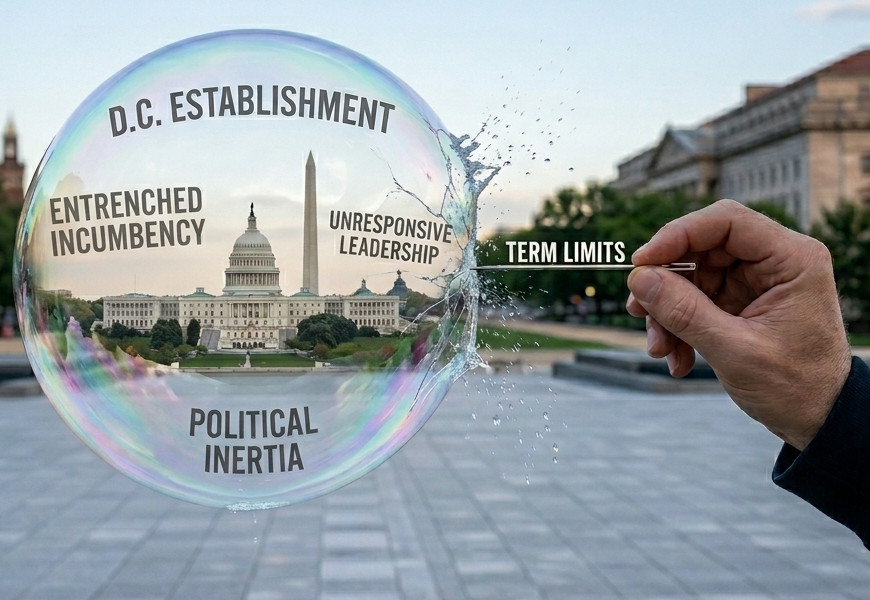
As the momentum for congressional term limits continues to accelerate, it’s clear that the bubble isolating Washington from its constituents is about to pop.
So far, 14 states have officially called for an amendment-proposing convention limited solely to the subject of congressional term limits. Arizona and Kansas joined the movement in 2026, proving its relevance to legislators and their constituents.
At the same time, a growing number of federal representatives are signing the U.S. Term Limits pledge, committing themselves to supporting and voting in favor of a constitutional amendment for congressional term limits.
These two efforts aren’t operating in vacuums—they are two gears in the same machine, creating a powerful pincer movement on Congress. On one side, voters are pressuring federal lawmakers to sign the pledge. On the other side, state legislatures are applying a constitutional squeeze, essentially telling Washington: “If you don’t propose an amendment to limit your own power, we are going to bypass you and do it ourselves.”
But this strategy raises a crucial question about the ultimate end game.
Whether an amendment is proposed by Congress or by the states through a convention, it still faces a massive final hurdle: ratification by three-quarters of the states. That means 38 states must approve it.
Because it only takes 34 states to call a convention—and we expect Congress to crack and preemptively propose the amendment themselves once 30 or so states sign on.
Superficially, it looks like ratification is the harder climb; after all, it requires four more states than a convention call, however history and political reality tell a completely different story. Proposing the amendment is the steep mountain; ratification is the downhill coast.
The Numbers Behind the Constitutional Gauntlet
To understand why the proposal stage is the true gatekeeper, you only have to look as far as the staggering historical data of American constitutional amendments:
| Stage | The Reality | The Historical Track Record |
| Introduced | Any lawmaker can write one. | ~12,000 amendments introduced in U.S. history. |
| Proposed | Requires 2/3 of Congress or 34 states. | Only 33 have ever been successfully proposed. |
| Ratified | Requires 3/4 of states (38 states total). | Only 27 out of those 33 were ratified. |
The math is clear: getting an amendment proposed is an exceedingly rare, but once an amendment is actually approved by two-thirds of Congress and sent to the states for ratification, its chance of survival skyrockets to 82%. Historically, most of the 27 ratified amendments were approved by the states within a single year of being proposed.
The rare amendments that die during the ratification phase are almost always deeply polarizing social issues. Congressional term limits do not fit that description—they enjoy overwhelming, cross-partisan public support.
Why the Wind Will Be at Our Back
There is a unique structural advantage to how this specific amendment will play out during the ratification phase.
The people voting on ratification are state legislators, not the members of Congress who are being term-limited. In fact, state legislators have a strong personal incentive to support federal term limits. Open seats in the U.S. House and Senate mean new career opportunities for ambitious state politicians looking to move up.
Furthermore, by the time an amendment is sent to the states for ratification, the hardest part of the groundwork will already be done.
Think about the math: if we need 30 to 34 states just to force Congress’s hand to propose the amendment, those 30+ states will have already voted on—and approved—the core concept of congressional term limits.
Shifting from a convention call to final ratification isn’t starting over from scratch. It’s activating a network of states that have already gone on the record in support of the measure. We won’t be building momentum from a dead stop; we will be riding a wave that has already crested.
Ratification will require fierce execution—but history shows that once we clear the hurdle of the proposal stage, the wind will be be firmly at our back.